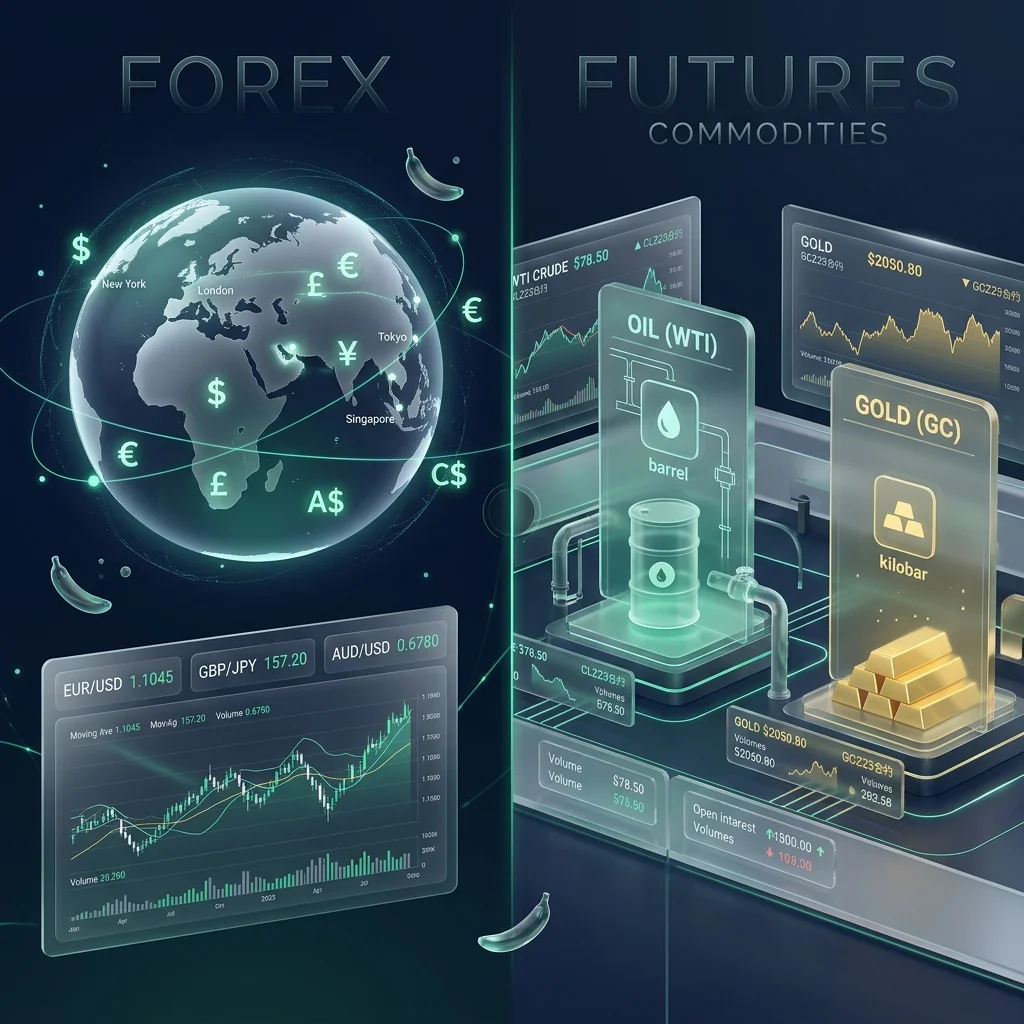
The Great Debate: Decentralization vs. Centralization
When you start your trading journey, you are inevitably faced with a choice: Do you trade the Forex market (the $7.5 trillion-a-day decentralized giant) or the Futures market (the centralized exchange-traded powerhouse)?
In 2026, the lines have blurred, but the underlying mechanics remains vastly different. Choosing the wrong market for your specific strategy is like trying to drive a Ferrari on a dirt road — you might have a great machine, but the environment will eventually destroy your performance.
This 2,000-word guide breaks down the structural differences, the cost of doing business, and which market offers the best path to prop firm funding.
1. Liquidity and the “Center of the World”
The primary difference between these two markets is Transparency. Forex is an "Over-the-Counter" (OTC) market. There is no central exchange. When you trade EUR/USD, you are trading against a network of banks and liquidity providers. Because there is no single ledger, you can never see the true "Volume" of the entire market. You only see the volume of your specific broker.
Futures, on the other hand, are traded on centralized exchanges like the CME (Chicago Mercantile Exchange). Every single contract bought or sold is recorded on a central ledger. This means you can see the Order Flow — exactly how many people are buying at a specific price. For traders who rely on "Volume Profile" or "Level 2" data, Futures are the undisputed winner.
The Data Edge: Because Futures have a central ledger, AI models like Toastlytics can perform much deeper "Liquidity Gap" analysis. In Forex, we rely on price-action derivatives; in Futures, we see the actual institutional footprints.
2. The Cost of Doing Business: Spreads vs. Commissions
In Forex, most retail brokers make their money from the Spread (the difference between the buy and sell price). While many offer "Raw Spread" accounts, you still face Slippage during high-impact news because the liquidity providers pull their orders.
In Futures, the spread is usually a single "Tick" (the minimum price move). You pay a fixed Commission per contract. For high-frequency scalpers, the predictability of Futures commissions is often preferred over the variable spreads of Forex.
The Hidden Cost: Swap
If you hold a Forex position past 5:00 PM EST, you pay or receive Swap (interest rate differential). Over weeks or months, this can eat significantly into a swing trader's profit. Futures contracts have no swap. You pay a "Roll" cost if you hold past the contract expiration, but for most traders, Futures are the cheaper instrument for multi-day holds.
3. Instrument Specialization
Forex is for the "Macro" Trader: If you love analyzing central bank policy, interest rates, and geopolitical shifts, Forex is your home. You can trade dozens of currency pairs, each with their own unique "Personality" (e.g., the volatility of GBP/JPY vs. the stability of EUR/CHF).
Futures is for the "Index" Trader: If you want to trade the S&P 500 (ES), the Nasdaq 100 (NQ), or Commodities like Oil (CL) and Gold (GC), Futures offer the cleanest execution. Most prop firm traders today gravitate toward the NQ because of its massive intraday range, allowing them to hit profit targets in a single session.
4. The Prop Firm Landscape: A Tale of Two Worlds
The prop firm industry is currently split between "Forex Firms" and "Futures Firms."
Forex Prop Firms (e.g., FTMO, FundedNext)
- Platform: Usually MT4/MT5.
- Rules: Typically use "Balance-Based" drawdown, which is more forgiving than trailing drawdown.
- Best For: Swing traders and those who prefer a 24/5 market with hundreds of instrument choices.
Futures Prop Firms (e.g., Topstep, Apex, MyFundedFutures)
- Platform: Tradovate, Rithmic, NinjaTrader.
- Rules: Frequently use "Trailing Drawdown" (moves up with peak equity). This is much harder to manage.
- Best For: Intraday scalpers who want real exchange data and high-volatility indices.
5. Which One Should You Choose?
The answer depends on your Analytical Style:
Choose Forex if: You trade from a laptop on the go, you prefer long-term macro trends, and you want a simple "Balance-Based" risk model. Forex is the entry-level market that scales into a global macro edge.
Choose Futures if: You are a data-driven "Quant" trader, you want to see exactly where big orders are sitting in the book, and you have the discipline to handle the "Trailing Drawdown" pressure. Futures are the professional's choice for precision scalping.
The Toastlytics Edge: Market Agnostic Intelligence
Whatever market you choose, the core problem remains: Data Fragmentation. Trying to track your Forex swap costs and your Futures commission slippage in the same head while managing a trade is impossible.
Toastlytics is market-agnostic. We plug into both MT5 and Tradovate to give you a unified view of your risk. We translate the "Ticks" of Futures and the "Pips" of Forex into a single language: The Toast Score. We help you identify if you are statistically better at trading EUR/USD or the NQ, so you can stop guessing and start specializing.
Not sure which market suits your personality? Join the Toastlytics waitlist. Our AI Coach analyzes your trading style and recommends the instrument that maximizes your specific edge.
Compare market dynamics in London, New York, Mumbai, and Singapore.