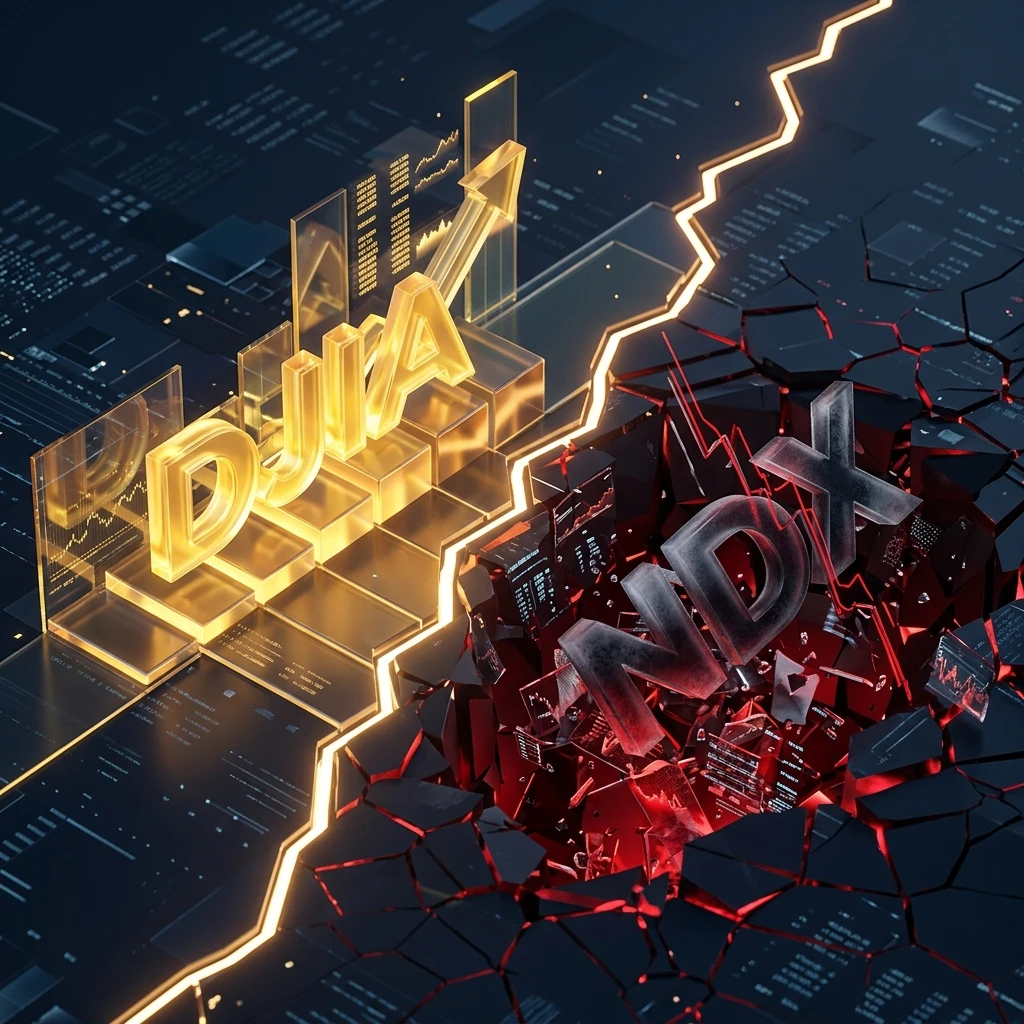
Today, the market isn’t just mixed; it’s a tale of two cities, each running its own script. On one side, the Dow Jones Industrial Average is celebrating record highs, a picture of old-economy resilience. On the other, the Nasdaq Composite is nursing a significant dip, with the high-flying AI darlings leading the retreat. For prop firm traders, this isn’t merely a headline; it’s a critical juncture demanding a nuanced understanding of market dynamics. Are we witnessing the start of an AI bubble deflating, or a healthy, much-needed correction and sector rotation? The answer dictates your next move.
This divergence is more than a statistical anomaly; it’s a symptom of a deeper, dual market reality. While broader macroeconomic currents like renewed US-Iran hostilities, elevated oil prices, and hawkish central bank rhetoric (BOJ, ECB) are injecting a pervasive risk-off sentiment, the equity market’s internal mechanics are telling a more complex story. The key is to stop treating “the market” as a monolithic entity and start dissecting its disparate narratives.
The AI Calibration: From Euphoria to Examination
The recent stumble in AI stocks, epitomized by Broadcom’s earnings miss and the subsequent selloff in semiconductor giants like Micron Technology and CrowdStrike, isn’t just a blip. It’s a stark reminder that even the most revolutionary narratives eventually confront the cold hard facts of valuation and delivery. Broadcom’s CEO not raising the full-year AI chip target, coupled with analysts flagging a slide in chip prices and a slowdown in AI spending, sent a shiver through the sector.
For months, the AI narrative has been a relentless upward escalator, fueled by FOMO and the promise of exponential growth. Now, we’re seeing the market’s discerning eye begin to focus on the sustainability of that growth. This isn’t necessarily a doomsday scenario for AI, but it is a critical calibration. Traders who piled into these names purely on momentum, without a robust understanding of their underlying fundamentals or risk-adjusted valuations, are now feeling the squeeze. The question isn’t whether AI is transformative, but whether its immediate market capitalization reflects future realities or current hype. This profit-taking and re-evaluation phase is essential for healthy market progression, but it can be brutal for those caught on the wrong side.
The Dow’s Quiet Strength: A Different Kind of Resilience
Contrast the Nasdaq’s tech woes with the Dow’s ascent. The Dow, often seen as a barometer for more established, cyclical industries, is finding strength precisely where the Nasdaq is faltering. This isn’t accidental; it’s a classic sign of sector rotation. As money flows out of potentially overvalued growth stocks, it seeks refuge and opportunity in sectors perceived as more stable, undervalued, or less susceptible to the immediate whims of speculative tech. Healthcare, financials, and other “old economy” stalwarts are likely beneficiaries.
This resilience in the Dow isn’t about ignoring the macro headwinds. Instead, it suggests that a segment of the market is either finding value plays, or it’s simply reacting to a delayed appreciation of fundamentals that aren’t tied to the AI frenzy. It’s a market that’s diversifying its bets, recognizing that not all boats rise and fall with the same tide. This provides a crucial counter-narrative to the tech-centric view, offering alternative avenues for capital deployment and risk mitigation.
Macro Crosscurrents: Fueling the Divergence
Adding another layer of complexity are the global macro factors. Renewed US-Iran hostilities and persistent Middle East tensions are keeping oil prices elevated, pushing global markets into a risk-off mode. Gold is seeing demand, and even the US dollar is catching a bid as a safe-haven, despite mixed domestic labor market signals (US small business hiring plans dropping). Bitcoin’s sharp plunge, driven by record ETF outflows and extreme fear, further underscores this macro-driven risk aversion, correlating with the broader selloff in risk assets, including parts of the equity market.
Simultaneously, we have central banks tightening their grip. The Bank of Japan is facing a stronger case for a June rate hike due to rising real wages, while the ECB is increasingly expected to hike rates next week despite an unexpected Eurozone GDP contraction. These hawkish shifts mean tighter liquidity and higher borrowing costs, which disproportionately impact growth stocks that rely on future earnings potential and cheaper capital. Value stocks, with their more immediate cash flows and often lower debt burdens, tend to weather such environments better. This combination of geopolitical uncertainty and monetary tightening acts as a powerful catalyst, exacerbating the divergence between growth and value, and thus between the Nasdaq and the Dow.
Actionable Intelligence for Prop Firm Traders
Navigating this dual market reality requires a shift from broad-stroke analysis to surgical precision.
- Stop Trading “The Market”: Your edge now lies in distinguishing between indices and sectors. Don’t assume a general “equity market” direction. The Dow and Nasdaq are telling different stories. Focus on individual index components.
- Embrace Sector Rotation: Actively seek out sectors gaining traction (e.g., healthcare, financials, industrials) and those facing headwinds (e.g., semiconductors, specific AI names). This is where the alpha resides. Consider pairs trades or long/short strategies within the equity space.
- Dynamic Risk Sizing: The mixed sentiment means increased choppiness and potential for swift reversals. Adjust your position sizes. If you’re betting on a directional move, ensure your risk per trade is scaled appropriately. Use a robust tool like our /tools/risk-calculator to model potential outcomes and ensure you’re not overleveraged in volatile names.
- Monitor Correlations (and their breakdowns): The typical correlations might be shifting. Bitcoin’s recent correlation with the Dow in a macro-driven risk-off move is a fascinating example. Understand which assets are moving together and which are decoupling. This informs your diversification and hedging strategies.
- Trade the Narrative, Not Just the News: Understand the why behind the price action. Is it a fundamental re-evaluation, a sentiment shift, or a macro-driven rotation? Each requires a different trading approach and risk profile.
The current market is a masterclass in complexity. It’s not about being bullish or bearish on “equities,” but about being acutely aware of the underlying currents pulling different segments in different directions. Your ability to dissect these narratives, identify the catalysts, and adapt your strategies will be the defining factor in your performance.
The market is rarely simple, and today is a prime example. The Dow’s ascent amidst the Nasdaq’s tech retreat, all against a backdrop of geopolitical tension and hawkish central banks, demands more than just a passing glance. It demands analysis, adaptability, and disciplined execution. Don’t get caught flat-footed by the conflicting signals. Leverage the power of objective analysis and rigorous journaling. If you’re struggling to make sense of these complex interplays, remember that the Toastlytics AI Coach is designed to help you cut through the noise, identify your biases, and refine your approach.