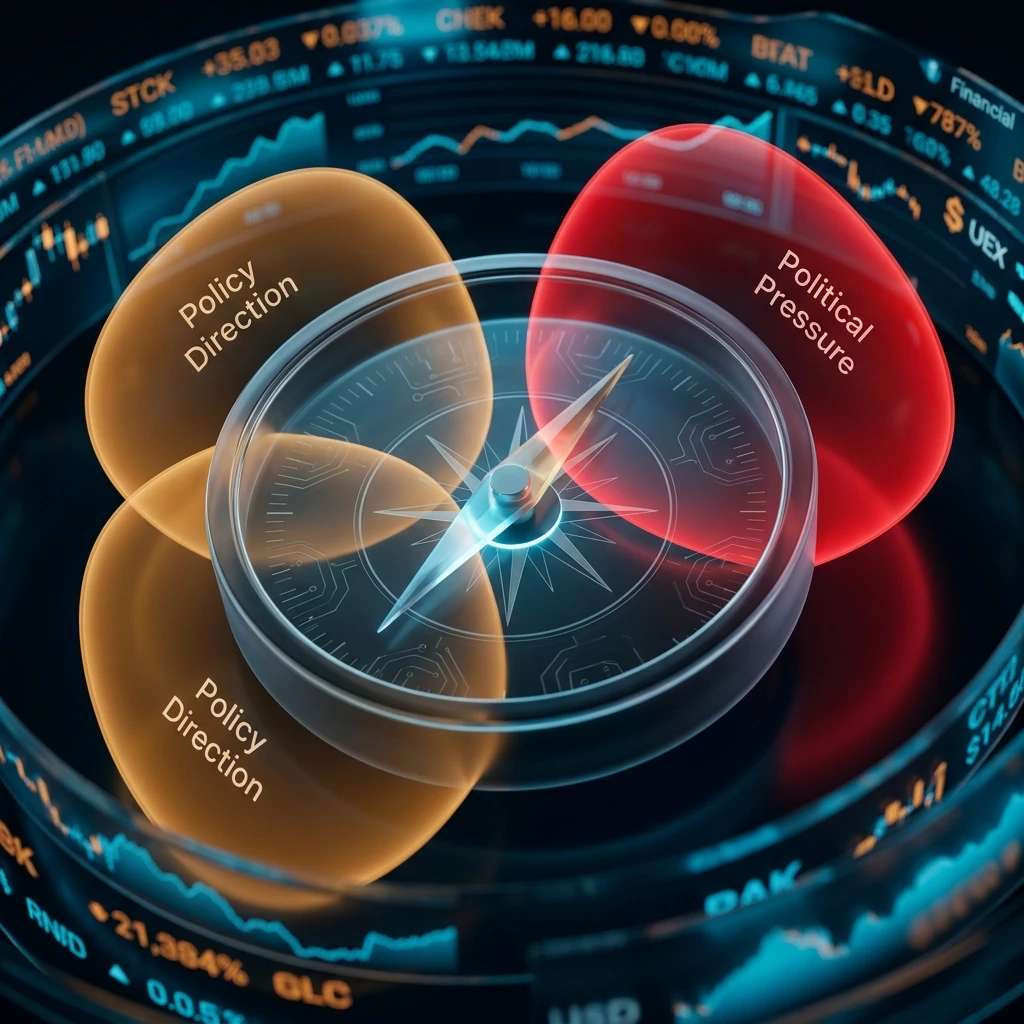
The market is a fascinating beast today, caught in a swirling vortex of conflicting signals. On one hand, a monumental US-Iran peace deal has sent oil tumbling and risk assets soaring, painting a picture of global de-escalation. On the other, central banks are anything but unified: the ECB just hiked, the BOJ is poised for its biggest hike in decades, and the RBA is hitting the brakes. But amidst this global symphony of monetary divergence and geopolitical calm, one discordant note stands out, demanding your laser focus: the impending test for new Federal Reserve Chairman Kevin Warsh.
This isn’t just another FOMC meeting. This is Warsh’s baptism by fire, a crucible moment that will define his tenure and, critically, dictate the short-to-medium term trajectory of the US Dollar, bond markets, and global asset allocation. For prop firm traders, understanding the nuances here isn’t optional; it’s the difference between navigating opportunity and getting steamrolled by political crosscurrents.
The Warsh Test: Policy, Politics, and Perception
Chairman Warsh steps into the most politically charged Fed seat in recent memory. While the bond market is pricing in further rate hikes to combat persistent inflation, President Trump has made his preferences for a more accommodative monetary policy abundantly clear. This isn’t subtle nudging; it’s a direct challenge to the Fed’s cherished independence, and Warsh’s response will send ripples far beyond Washington.
The insight here isn’t just “Fed meeting = volatility.” It’s “Fed meeting + new Chair + political interference = unprecedented signal noise.” Traditional Fed-speak, usually a carefully calibrated ballet of forward guidance, is now subject to a new variable: the perception of political influence. How Warsh frames the economic outlook, the inflation fight, and the path of future rates will be scrutinized not just for its economic merit, but for its implicit defiance or capitulation to political pressure.
Consider the backdrop: the Middle East peace deal just took a significant chunk out of energy inflation. This should give the Fed more breathing room. However, the market’s expectation for further hikes remains, driven by underlying domestic price pressures. Warsh’s dilemma is acute: does he lean into the de-escalation narrative to justify a softer stance, potentially aligning with political wishes but risking his anti-inflation credibility? Or does he double down on hawkishness, asserting independence but potentially incurring political wrath and slowing an already stalling manufacturing sector?
Navigating the Fed’s Political Fog: Actionable Intelligence for Prop Firms
-
Beyond the Headline Rate: Dissect the Nuance. The immediate rate decision (or lack thereof) will grab headlines, but the real intelligence lies in the accompanying statement and, more importantly, Warsh’s press conference. Look for:
- Subtle language shifts: Any deviation from previous hawkish rhetoric, even minor, will be amplified. Pay attention to adjectives used to describe inflation (“transitory” returning?), growth, and labor markets.
- The Dot Plot’s Dissonance: This is where the rubber meets the road. Does the median dot shift significantly? More critically, how many members project fewer hikes than anticipated? A wider dispersion of dots could signal internal dissent, indicating a less unified front and making future policy less predictable.
- Warsh’s Composure under Pressure: How does he answer questions about political interference? Does he assert the Fed’s independence unequivocally, or does he offer vague, conciliatory remarks? His body language and tone will be as important as his words.
-
Trade the Narrative, Not Just the Number. Initial market reactions can be head fakes. The true direction will be determined by the market’s interpretation of Warsh’s overall narrative. If he successfully projects an image of independent, data-driven policymaking, the USD could strengthen on renewed confidence, even if the immediate decision is neutral. Conversely, any hint of political capitulation could undermine USD confidence, even with a hawkish tilt. This is a game of credibility, not just arithmetic. Be prepared for whipsaws and focus on sustained breaks of key technical levels after the initial noise settles.
-
Elevated Risk, Enhanced Vigilance. When political variables enter the monetary policy equation, volatility spikes. Standard deviation models often fail to capture this type of uncertainty. Your risk management protocols must be ironclad.
- Position Sizing: Consider reducing your typical position size around this event. It’s better to miss a portion of a move than to blow through your daily drawdown limit on an unpredictable swing.
- Stop-Loss Placement: Wider stops might be tempting to avoid being wicked out, but that increases potential loss. Instead, focus on dynamic stops based on clear technical levels, and be prepared to adjust quickly.
- Know Your Limits: Understand your firm’s daily and maximum drawdown rules intimately. This is not the time to be a hero. Use our risk calculator to properly size your trades relative to your account and firm’s rules.
-
Intermarket Correlations: The Domino Effect. The Fed’s stance under Warsh will ripple globally.
- USD Index: The primary beneficiary or casualty. A strong, independent Warsh could bolster the dollar; a perceived weak or politically influenced Fed could see it tumble.
- US Treasuries: Yields will react sharply. A hawkish Warsh will likely push yields higher, a dovish one lower. This impacts global bond markets and funding costs.
- Gold (XAU/USD): The peace deal already made gold attractive by curbing rate hike expectations. If Warsh leans dovish, gold’s appeal as a non-yielding asset increases further. If he’s surprisingly hawkish, gold could pull back despite geopolitical calm.
- USD/JPY: The BOJ’s aggressive tightening means JPY is already under pressure. A hawkish Warsh could exacerbate USD/JPY strength, but a dovish turn could give JPY a much-needed reprieve, especially if the market perceives political risk in the USD.
-
The China Factor: A Secondary Headwind. Don’t forget China’s projected consumer spending contraction. While the peace deal is positive, a slowing Chinese economy is a significant global headwind. If Warsh takes a dovish turn, it might initially boost risk sentiment, but a deep Chinese slowdown could quickly overshadow that, leading to a “risk-off” environment despite the Fed’s stance. This is where the mixed sentiment truly comes into play.
The Bottom Line: Prepare for the Unexpected
Warsh’s first major policy decision is less about the numbers and more about his leadership, his independence, and his ability to project a consistent, credible path forward amidst internal and external pressures. For prop firm traders, this means discarding assumptions, sharpening your intermarket analysis, and doubling down on rigorous risk management. Your edge won’t come from guessing the exact outcome, but from flawlessly executing your plan in a volatile, politically charged environment.
This is where your trading journal becomes your most potent weapon. Document your pre-event analysis, your entry/exit criteria, and your emotional state. Post-event, review why the market reacted as it did, and how your psychological biases might have influenced your decisions. The lessons learned from Warsh’s crucible will be invaluable for your long-term success.