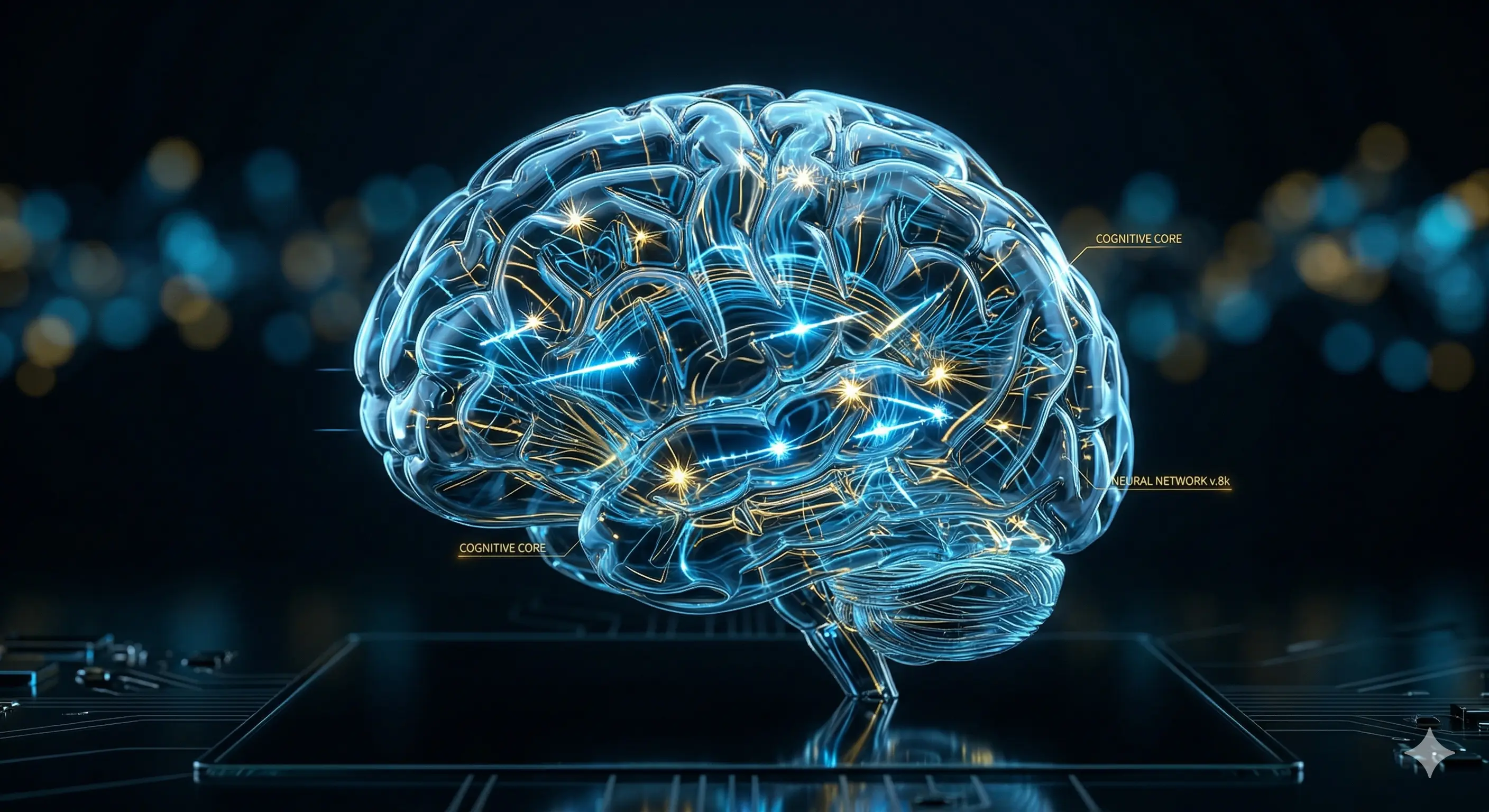
The Black Box vs. The Glass Box
In 2026, the term "AI" is thrown around by every trading platform as a buzzword for simple statistical alerts. But at Toastlytics, we don't just use statistics; we use Neural Architectures. The difference is as wide as the gap between a calculator and a human brain.
Most traders are afraid of "Black Box" AI—systems that tell you what to do without explaining why. Our philosophy is the Glass Box approach: using deep-learning models to find hidden patterns in your data and then presenting them in a way that you can actually understand and use.
The core of our technology is built on a custom Transformer-Based Architecture, specifically fine-tuned for high-frequency behavioral data. Here's how it works at the code level.
Phase 1: Feature Extraction (The “Hidden” Signals)
When you connect your broker feed, the AI begins a process called Feature Engineering. It takes the raw data—entry time, exit price, size—and creates hundreds of "hidden" features that no human could track simultaneously.
- The Micro-Sentiment Index: How does your win rate change based on the speed of the tape during the 5 minutes preceding your entry?
- The Execution Decay Gradient: At what exact point in your session does your slippage begin to increase? AI finds the curve where your execution quality starts to erode due to fatigue.
- The Cognitive Load Correlation: By cross-referencing your trade frequency with market volatility, the models identify the "break point" where the market's complexity exceeds your ability to process it.
The Data Science: We don't just look at whether you made money. We look at the Variance in Decision Quality. AI identifies if you made $1,000 because of a good process or because of a lucky exit in a thin market.
Phase 2: Predictive Performance Modeling
The most advanced part of our engine is the Predictive Model. By training on millions of anonymized trades across the community, our AI has learned the "Pre-Failure Signatures" that lead to blown accounts.
The “Drawdown Prediction”
Long before you hit the max drawdown limit on your prop firm account, the AI observes a shift in your Probabilistic Distribution. Your winners start to cluster in certain market environments, while your losers become more "random." Our model recognizes this as Edge Drift. It allows us to notify you: "Based on your last 10 execution cycles, you are currently in a high-probability drawdown phase. Recommendation: Risk -50% for the next 3 sessions."
The Behavioral Mirror
Using a technique called Pattern Matching, the AI compares your current session's behavior to your historical "Peak" performance. If your current entry speed and duration don't match your historical winners, the system flags it as "Off-Plan Behavior." It isn't telling you how to trade; it's telling you how you trade best.
The Human-in-the-Loop Concept
At Toastlytics, we believe AI shouldn't replace the trader; it should Augment the trader. This is the Centaur Model—the combination of human intuition and mechanical precision.
By using the AI as a "Co-Pilot," you leverage the machine's ability to process vast amounts of data without the emotional bias that hampers human decision-making. The Neural Edge isn't about letting a bot trade for you; it's about having an elite data scientist in your corner 24/7, making sure your own internal "model" is as sharp as it can be.
- Step 1: The AI Onboarding. Connect your data and let the system train on your last 100 trades to build your initial "Profile."
- Step 2: Monitoring. Run the platform during your live sessions to see "Real-Time Drift" alerts.
- Step 3: Post-Session Audit. Review the AI's "Executive Summary" to see exactly where you deviated from your own historical edge.
The future of trading isn't just about candles and trendlines; it's about the Neural Synergy between you and your data. Welcome to the invisible edge.