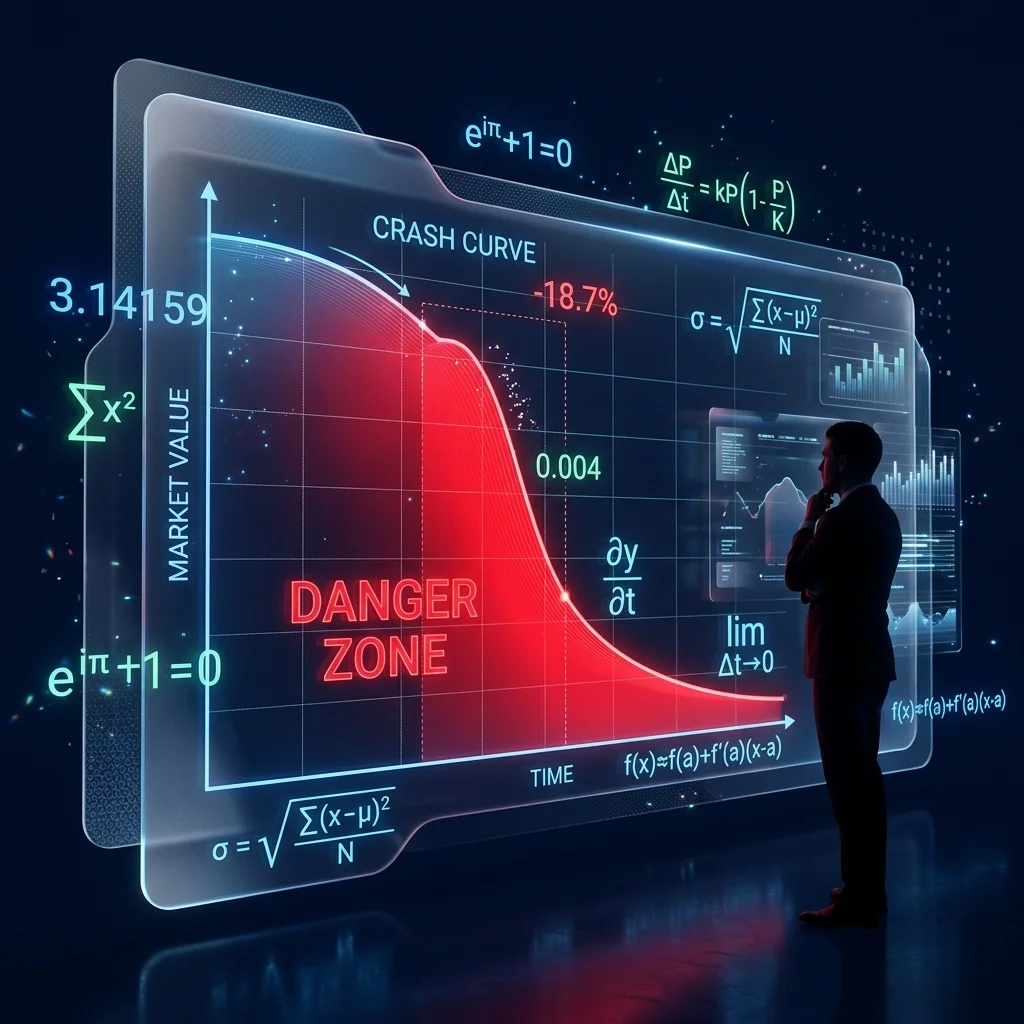
The Asymmetry of Loss: Your Biggest Mathematical Enemy
In school, we are taught that math is linear. If you lose $10 and find $10, you are back to where you started. In the world of trading, this logic is not just wrong — it is financially fatal. Trading math is non-linear and asymmetrical.
When you lose capital, you lose more than just money; you lose your Leverage Power. Because your next trade is calculated based on a smaller balance, you have to work significantly harder just to get back to breakeven. This is the fundamental trap that kills 90% of retail traders.
The Non-Linear Recovery Curve
| Loss of Capital | Gain Needed to Recover |
|---|---|
| 5% | 5.3% |
| 10% | 11.1% |
| 20% | 25% |
| 30% | 42.9% |
| 50% | 100% |
| 90% | 900% |
As you can see, once you hit a 20% drawdown, the difficulty of recovery begins to accelerate exponentially. By the time you hit 50%, you are essentially asking for a miracle. This is why Capital Preservation is not a "boring" defensive strategy — it is a mathematical requirement for survival.
The Anatomy of a Breach: The Negative Feedback Loop
Toastlytics original research shows that a breach (failing an account) isn't a single event. It is a process. We call this the Negative Feedback Loop. It typically follows a predictable 5-step sequence:
- The Initial Shock: A string of 3-4 losses puts the trader in a 3% drawdown. The brain enters "Threat Mode."
- The Stop-Loss Compression: To "recover faster," the trader tightens their stops to increase their R:R. However, tighter stops are more likely to be hit by normal market noise (market "breathing").
- The Frequency Spike: Because stops are tighter, the trader is stopped out more often. This triggers "Loss Aversion" and increases emotional pressure.
- The Lot-Size Creep: Frustrated, the trader doubles their position size to "make it all back in one trade."
- The Mathematical Point of No Return: The trader is now so close to the daily or total loss limit that any minor tick against them results in a breach.
The Science of “Risk of Ruin”
The Risk of Ruin is a mathematical formula used to determine the probability of an account hitting zero (or a breach limit) based on win rate and risk per trade. Most retail traders operate with a Risk of Ruin of **above 80%**, even with a "profitable" strategy.
The primary driver of the Risk of Ruin is Variance. Even a strategy with a 60% win rate can, and will, eventually hit a string of 8-10 consecutive losses. If you are risking 2% per trade, a 10-loss streak is a 20% drawdown — which, as we've seen, requires a 25% gain to recover. You have just significantly increased your mathematical difficulty for the rest of the month.
Institutional Standard: Most professional hedge fund managers are required by their risk committees to stay below a 1% Risk of Ruin. This usually translates to risking no more than 0.25% to 0.5% per trade.
Volatility Clustering: The Drawdown Accelerator
In finance, volatility is not evenly distributed. It tends to cluster. High volatility days are usually followed by more high volatility days. This is where most drawdowns accelerate into breaches.
When market volatility spikes (e.g., during a geopolitical event or a CPI release), your fixed stop-loss distances become "smaller" relative to the market's movement. A 20-pip stop that was safe on Monday is now "noise" on Tuesday. If you don't adjust your position size down to account for the wider stops needed in high volatility, you are effectively increasing your risk without realizing it.
The “Half-Risk” Protocol: How to Recover Like a Pro
When a professional trader enters a drawdown of more than 3%, they don't try to "win it back." They do the opposite: they **de-risk**.
The Protocol:
- At 2% drawdown: Reduce risk per trade by 50%.
- At 4% drawdown: Reduce risk per trade by another 50% (trading at 25% of normal size).
- The Goal: Stay in the game. You are no longer trading for profit; you are trading for Calibration. Once you have a string of 3 winning trades at half-risk, you have "earned" the right to move back to full risk.
This protocol effectively "flattens" the bottom of your equity curve, preventing the exponential acceleration of the recovery gap.
Case Study: The $150k Account Rescue
A trader was down $4,500 on a $150k challenge (3% drawdown). Instead of "swinging for the fences," they switched to 0.25% risk per trade. It took them 12 trading days and 28 trades to get back to breakeven. During this time, they focused exclusively on Perfect Execution. Because they were trading small, their stress levels were low (confirmed by their Toastlytics emotion tags). Once back to breakeven, they returned to 0.5% risk and passed the challenge 5 days later. A "slow" recovery is always faster than a "blown" account.
Why Discipline is the Wrong Tool for the Job
Stop blaming your "mindset." Discipline is a finite biological resource. If you spend your entire session "trying not to overtrade," you are depleting the very mental energy you need to execute your strategy correctly.
You shouldn't use your brain to track your drawdown limits. That's what machines are for. Manual calculation is prone to error, especially when the Amygdala is active. Toastlytics was built to be your "External Prefrontal Cortex." We track your distance to breach in real-time, accounting for live spreads and swap, so you can focus on the only thing that matters: **The Setup.**
Stop fighting the math alone. Join the Toastlytics waitlist and let our AI-driven risk guardrails protect your capital. We turn mathematical traps into calculated opportunities.
Explore more quantitative insights in London, New York, Mumbai, and Singapore.