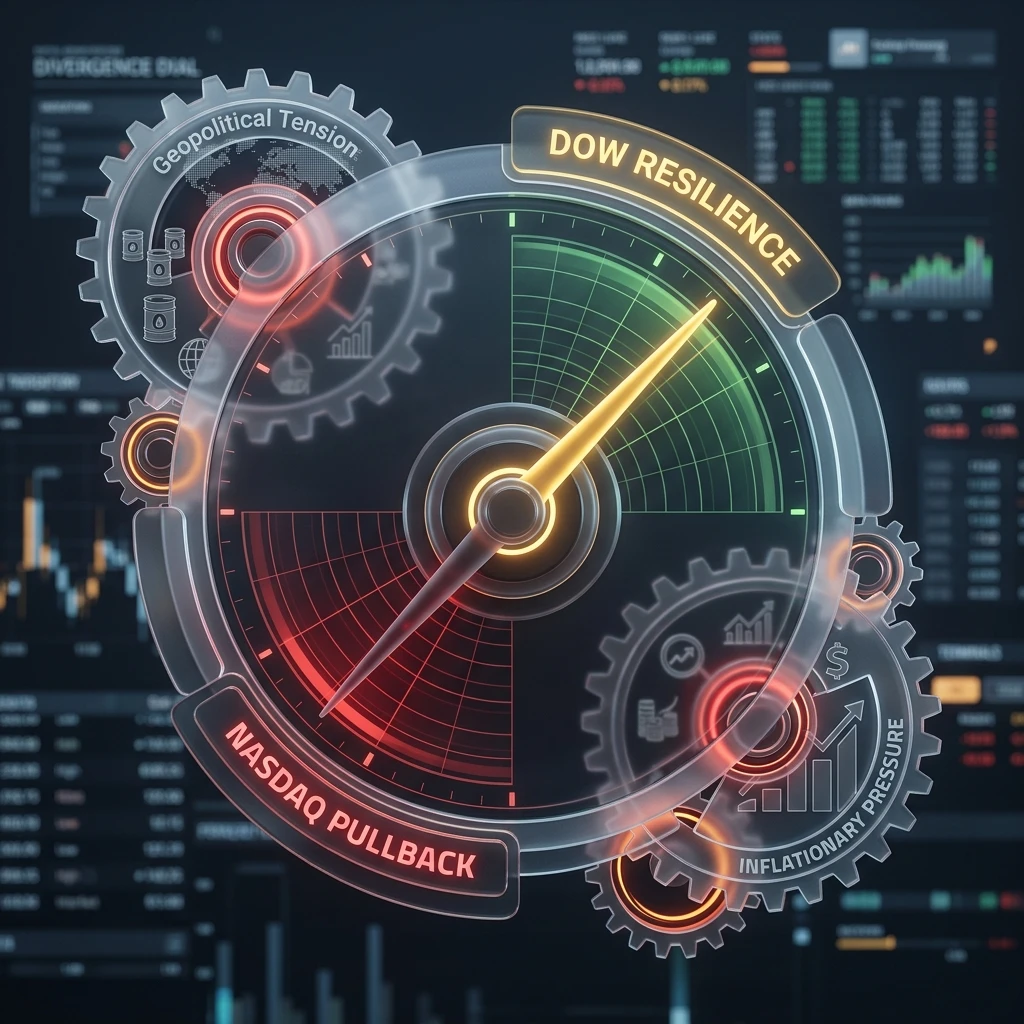
The market isn’t just “mixed” today; it’s undergoing a fundamental recalibration driven by forces far beyond a simple earnings miss or a central bank speech. What we’re witnessing is the “Geopolitical Divergence Drift”—a stealth rotation where traditional growth engines are stalling, while safe havens and inflation hedges gain traction, all under the persistent influence of global tensions and their cascading economic effects. For prop firm traders, this isn’t merely noise; it’s the defining characteristic of current market structure, demanding a strategic pivot.
On one side, the Dow Jones Industrial Average is hitting record highs, a testament to the resilience of traditional sectors like healthcare and financials. On the other, the Nasdaq composite is bleeding, dragged down by a significant pullback in AI darlings like Micron Technology and CrowdStrike, exacerbated by Broadcom’s earnings miss and muted AI chip outlook. This isn’t just sector rotation; it’s a symptom of deeper macro currents. Meanwhile, Bitcoin, often seen as a risk-on barometer, is plunging amid record ETF outflows, signaling a broader, macro-driven risk-off sentiment. These aren’t isolated incidents; they’re interconnected threads in a complex tapestry.
The “unseen hand” isn’t just dictating direction; it’s orchestrating a profound divergence in market performance, making uniform strategies obsolete. Your edge now lies in understanding these underlying drivers and adapting your tactical execution.
The Unseen Hand: Geopolitics, Oil, and Currency Wars
Let’s cut to the chase: renewed US-Iran hostilities and persistent Middle East tensions are not just headlines; they are direct inputs into your trading models. This isn’t abstract risk; it’s tangible, immediate, and impacting every asset class you touch.
Elevated oil prices, a direct consequence of geopolitical friction, are a double-edged sword. They fuel inflation expectations globally, putting central banks in a bind. The ECB, for instance, is increasingly expected to hike rates next week, despite an unexpected Eurozone GDP contraction. This hawkish stance, driven by persistent inflation overshoot, is giving the Euro a surprising lift against a backdrop of weak economic data. For EUR/USD traders, this means ignoring the GDP miss and focusing on the central bank’s inflation mandate, which is heavily influenced by energy costs.
Then there’s Japan. The news that Japan used US Treasuries to fund Yen intervention is a game-changer. This isn’t just about USD/JPY hitting arbitrary levels; it’s about the explicit use of foreign reserves, a move that will undoubtedly attract US attention and potentially influence future intervention strategies. Coupled with rising real wages, the case for a BOJ rate hike in June is strengthening. This sets up a fascinating dynamic for USD/JPY: the fundamental pressure for JPY appreciation (BOJ hawkishness) versus the technical and psychological resistance from intervention. Prop firm traders need to be extremely nimble here, respecting potential short-term intervention spikes while positioning for the longer-term fundamental shift.
The takeaway? Geopolitical developments and their immediate impact on crude oil prices are directly influencing central bank hawkishness and currency flows. This isn’t a secondary factor; it’s a primary driver of volatility and directional bias in major forex pairs and commodities.
The Tech Reckoning: Nasdaq’s Reality Check
While the Dow celebrates, the Nasdaq is experiencing a necessary, albeit painful, reality check. The AI narrative, while powerful, appears to have outrun valuation metrics for some key players. Broadcom’s earnings miss and the lack of an increased full-year AI chip target acted as a significant catalyst, sparking a broad selloff in semiconductor stocks. Analysts are flagging slowing AI spending and chip price slides – signals that the tech gravy train might be slowing down, at least for now.
This isn’t just a blip. It’s a rotation, a re-evaluation of where capital should be deployed in a high-inflation, high-geopolitical-risk environment. Money is moving out of speculative growth and into sectors perceived as more stable or defensive, like healthcare and financials, which explains the Dow’s unexpected strength.
For crypto traders, Bitcoin’s plunge isn’t an isolated event either. Record ETF outflows and “extreme fear” sentiment, coupled with its correlation to the Dow (albeit in a risk-off inverse manner), underscore its vulnerability to broader macro shifts. When the big money gets risk-averse due to geopolitical tensions and rising Treasury yields, even the most passionate HODLers feel the pinch.
Prop Firm Playbook: Navigating Divergent Currents
The “Geopolitical Divergence Drift” demands a refined approach. Here’s how to apply actionable intelligence today:
1. Master Intermarket Analysis with a Geopolitical Lens
Forget analyzing charts in isolation. Every asset is a piece of a larger puzzle, and geopolitics is the hand moving the pieces.
- Crude Oil (WTI, Brent): Monitor for spikes driven by Middle East headlines. Higher oil means higher inflation expectations, which translates to hawkish central bank sentiment (e.g., ECB). This can support currencies like EUR despite weak local data.
- Gold (XAU/USD): This is your classic safe-haven play. Renewed US-Iran hostilities are a direct tailwind for Gold. Watch for correlation with USD strength.
- USD: The dollar is benefiting from both safe-haven flows due to global risk-off and rising US Treasury yields. However, be mindful of potential selling pressure from countries like Japan using Treasuries for intervention.
- JPY Crosses: USD/JPY is a battleground. While the BOJ’s hawkish shift provides fundamental support for the Yen, the threat of intervention (especially with US attention on Japan’s Treasury holdings) introduces significant volatility. Consider JPY strength against other risk-on currencies (e.g., AUD/JPY) if global risk-off persists.
- Tech Indices (Nasdaq): Look for continued weakness and potential short opportunities on rallies. The narrative of overvaluation and slowing AI spending is gaining traction.
2. Sharpen Your Risk Management
In a market defined by divergence, volatility is your constant companion.
- Dynamic Position Sizing: Reduce your exposure on highly correlated or volatile assets. If you’re trading a tech stock, understand its correlation to the broader Nasdaq and adjust size accordingly. For instance, if you’re long EUR/USD based on ECB hawkishness, ensure your position size accounts for unexpected geopolitical shocks that could strengthen the USD.
- Tighter Stops, Wider Targets (Selectively): While counterintuitive, tighter stops on volatile assets protect capital from sudden reversals, especially around geopolitical news. For assets with clear directional bias (like Gold in a risk-off environment), you might afford wider targets, but always protect your downside.
- Diversify Your Exposure: Don’t put all your eggs in one thematic basket. If you’re bullish on a particular sector, balance it with positions in safe-haven assets.
3. Capitalize on Contradictions
The market’s mixed signals are not confusing; they are opportunities for relative strength/weakness plays.
- Long Dow, Short Nasdaq (or specific tech stocks): This classic pair trade can capture the rotation from growth to value/defensive sectors.
- Long Gold, Short Bitcoin: In a macro-driven risk-off environment, Gold tends to outperform crypto, offering a potential arbitrage.
- Long EUR/USD (cautiously): Despite weak Eurozone GDP, the ECB’s inflation-driven hawkishness could provide short-term tailwinds. However, monitor US data and geopolitical sentiment, as strong USD safe-haven flows can quickly reverse gains.
Understanding your maximum daily drawdown and total drawdown limits is paramount in such a market. Utilize tools like the Toastlytics risk calculator to accurately size your positions and ensure you’re not overleveraged into unpredictable geopolitical events. Even a small position in a highly volatile asset can quickly erode capital if not managed properly.
The market is no longer a simple bullish or bearish story. It’s a complex interplay of forces, where geopolitical developments are the primary catalysts for profound divergence. Your ability to dissect these forces, adapt your strategy, and manage risk with surgical precision will be the difference between merely surviving and truly thriving.
Don’t let the conflicting headlines paralyze you. Instead, view them as a roadmap to asymmetric opportunities. Track these divergent currents, apply rigorous risk management, and let your trading journal be your guide through this turbulent, yet opportunity-rich, environment. The Toastlytics AI Coach can help you identify these patterns and refine your tactical responses, ensuring you’re always one step ahead in this Geopolitical Divergence Drift.