The Invisible Variable in Your P&L
Most traders treat their P&L as the absolute truth. They assume that if they made money, they traded well, and if they lost money, they traded poorly. This is a dangerous oversimplification. Your P&L tells you what happened, but without emotional context, it hides the why.
In the world of professional trading, we call this the Process vs. Outcome Gap. A winning trade taken in a state of FOMO is a "bad" trade because it reinforces a losing habit. A losing trade taken with perfect discipline is a "good" trade because it reinforces a winning process. Emotion tracking is the only way to separate the two.
A 2024 study on high-performance traders revealed that 85% of blown accounts were preceded by a period of "Emotional Volatility" that was not immediately apparent in the P&L. By the time the drawdown hit the equity curve, the behavioral failure was already two weeks old.
The Neurobiology of the Trade: Amygdala vs. Prefrontal Cortex
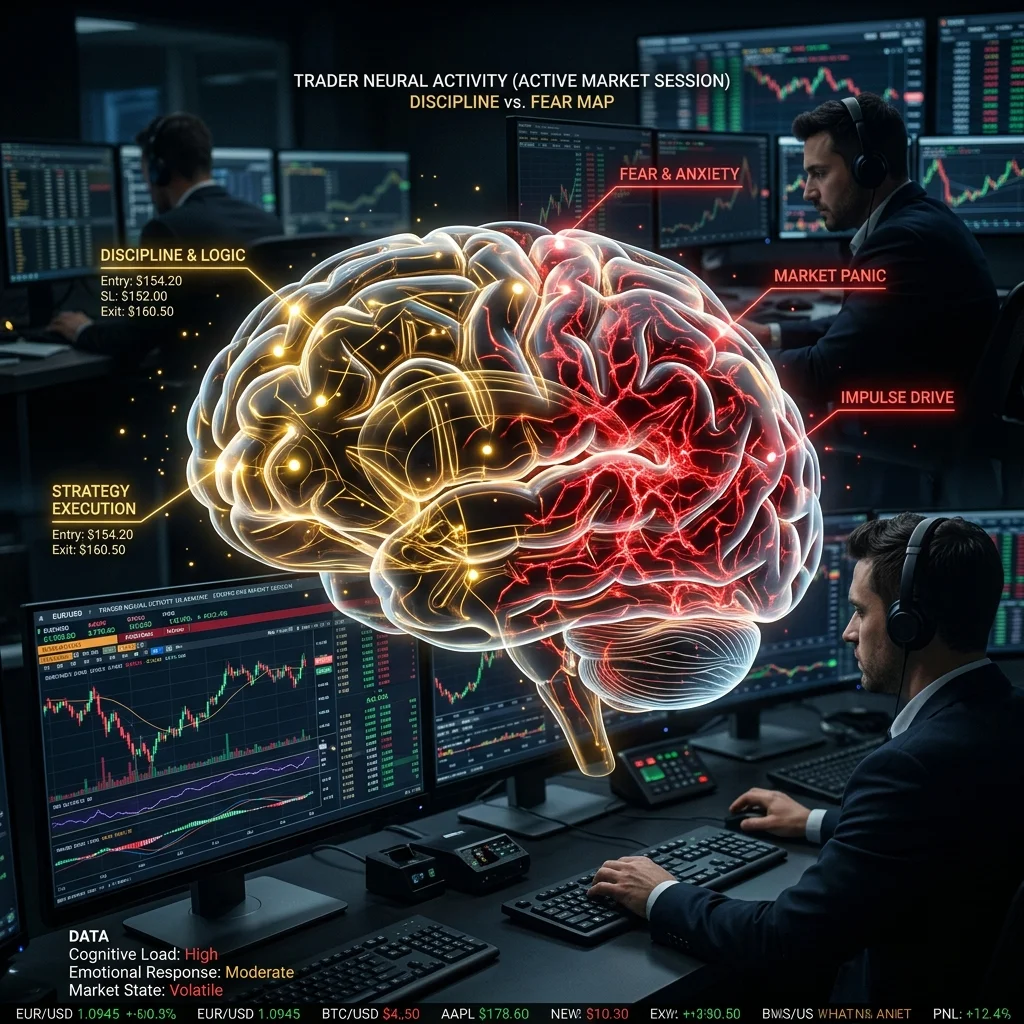
Trading is fundamentally an act of fighting your own biology. When you see a large candle moving against you, your Amygdala — the primitive part of your brain responsible for the "fight or flight" response — takes over. It floods your system with cortisol and adrenaline. Your heart rate spikes, your breathing becomes shallow, and your ability to think probabilistically vanishes.
Your goal is to stay in the Prefrontal Cortex — the part of the brain responsible for logic, planning, and long-term consequences. Emotion tracking acts as a "speed bump" for the Amygdala. By forcing yourself to label your emotion (e.g., "I am feeling Anxious"), you activate the prefrontal cortex, effectively "switching on" the logical part of your brain during the heat of battle.
The "Labeling" Effect: UCLA researchers found that simply putting a name to a negative emotion reduces activity in the amygdala. In trading terms: labeling your fear makes you less likely to act on it.
The 6 Emotional Archetypes (The Behavioral Tags)
You don't need a complex psychological profile. You need to track the specific states that lead to trade drift. At Toastlytics, we focus on these six archetypes:
- 1. The Cold Executioner (Calm/Logical): You are following your rules. You feel a detached neutrality toward the outcome. This is the "Gold Standard" of trading.
- 2. The Chaser (FOMO): You feel a physical pressure in your chest. You're afraid that if you don't enter now, the move of the month will happen without you. You usually enter at the worst possible price.
- 3. The Avenger (Revenge): You just took a loss. You feel "cheated" by the market. Your next trade isn't about the setup; it's about getting back to breakeven. This is the #1 killer of funded accounts.
- 4. The Gambler (Boredom): The market is quiet. You haven't taken a trade in 3 hours. You take a "low conviction" setup just to feel some action.
- 5. The Hesitator (Anxious/Fear): The setup is perfect, but you're afraid to pull the trigger because of a previous loss. You wait for "more confirmation," and by the time you enter, the R:R is ruined.
- 6. The Euphoric (Over-Confident): You're on a 5-trade winning streak. You feel invincible. You double your position size because "you can't lose." This is usually right before a massive drawdown.
Creating Your “Emotional Heatmap”
Once you have 50-100 trades tagged with these archetypes, the data starts to talk. A "Heatmap" allows you to see the correlation between your internal state and your external results.
Common Discovery: A trader might find that their "Calm" trades have a Profit Factor of 2.5, while their "Boredom" trades have a Profit Factor of 0.2. The takeaway isn't "don't be bored"; it's "don't trade when you're bored." By simply eliminating the archetype that correlates with your worst performance, you often double your P&L without finding a single new setup.
The Biological Connection: Sleep, Diet, and Resilience
You cannot separate your trading performance from your biological state. Emotional control is a finite resource (often called Ego Depletion). If you are sleep-deprived, your prefrontal cortex is effectively "offline," and your amygdala is in the driver's seat.
Advanced emotion tracking includes a Biological Pre-Flight Check:
- Sleep Quality: 1-10 score.
- Hydration: Are you trading with a "dry brain"?
- Caffeine/Stimulants: Over-caffeination is a leading cause of "impulse trades."
If your sleep is below a 5, your "Refusal Threshold" should be much lower. You are a biological machine; you wouldn't drive a car with no oil, so don't trade with no sleep.
Case Study: The “Wednesday Wobble”
A Toastlytics user noticed their performance dipped every Wednesday. They assumed it was a market cycle issue. However, their emotion tags showed they were consistently "Anxious" and "Bored" on Wednesdays. By digging deeper, they realized they were skipping their Tuesday night gym session and eating poorly mid-week. Their "market problem" was actually a "wellness problem." By fixing their Tuesday night routine, their Wednesday P&L turned from a consistent loser into their second-most profitable day.
Actionable Steps: How to Implement This Today
If you don't use Toastlytics yet, you can still start manually:
- Add a "Tag" column to your spreadsheet. Use the 6 archetypes mentioned above.
- Tag the trade AT ENTRY. Do not wait until the trade is closed. Your memory of your emotion will be biased by whether you won or lost (Hindsight Bias).
- Add a "Discipline Score" to each trade. 1 if you followed all rules, 0 if you broke even one.
- Review at the end of the week. Look for the correlation. Which emotion is your "Money Killer"?
The Future of Behavioral Intelligence
The next generation of traders won't just look at charts; they'll look at themselves. Biometric integration (heart rate variability, cortisol monitoring) and AI pattern recognition are turning "intuition" into a measurable, optimizable data point.
Toastlytics was built to automate this entire process. We identify your emotional failure modes before they become account blowouts. Because in the end, the most dangerous part of your trading setup isn't the market — it's you.
Want to see your emotional heatmap in real-time? Join the Toastlytics waitlist. We're building the first emotion-aware trading platform designed to protect you from yourself.
Explore more high-performance strategies in London, New York, Mumbai, and Singapore.